
42% of workers cite high or increased workload as their primary driver of workplace stress. (Mental Health UK Burnout Report, with YouGov (2026)).
74% of people feel so stressed they are overwhelmed or unable to cope with daily tasks. (Mental Health Foundation UK – “Stress: Are we coping?” report, with YouGov).
62% of Gen Z struggle to build meaningful relationships despite high digital connectivity. (What Matters 2025: Fulfilment Rewired Report by Human8).
Job insecurity is now a primary stressor for 75% of workers aged 18–25 and 65% of workers aged 26–43. (American Psychological Association (APA) 2025 Work in America survey, with The Harris Poll.)
70% of people struggle with chronic procrastination in areas of personal growth and important tasks. Shatz, I. (2024/2026). Solving Procrastination: A Science-Backed Guide to Understanding Why We Put Things Off.
The Ravio 2026 Compensation Trends Report (released in late 2025) found that the UK attrition rate hit 19%, representing an 11% increase compared to 2024.
Global employee engagement fell from 23% to 21% in 2024, only the second time in 12 years that global engagement has seen an annual decline. (Gallup State of the Global Workplace report 2025).
According to the World Economic Forum (WEF) Future of Jobs Report 2025, the skills gap has overtaken capital and regulation as the primary hurdle for businesses. 63% of employers worldwide cite skills gaps as the top barrier to transforming their business.
A 2025 study titled the Employee Pride Index, conducted by The Caffeine Partnership, highlights a significant disconnect between company employment and brand advocacy, with only 40% of UK employees recommending their company workplace.
51% of CFOs expect their contribution margins to increase. (Gartner 2026 Budget Assumptions Survey).
37% of adults have used an AI chatbot for mental health or wellbeing support. (Mental Health UK, conducted by Censuswide in late 2025).
15% of global podcast listening hours are focussed on health & wellness. (2025–2026 industry analyses by The Frank Agency.)
Less than 1 in 4 (29%) agree that their employer's wellbeing programmes are important and meet their needs. 2024 Wellbeing Diagnostic Survey, published by WTW (formerly Willis Towers Watson).
Only 24% of workers globally feel confident that they currently possess the skills necessary to progress in their careers. (ADP Research Institute's "People at Work 2025: A Global Workforce View" report.)
Only 12% of professionals currently have coaching or mentorship offered by their employer; (Progress Paused – 70% of employers admit to underinvesting in staff, a 2025 research poll conducted by Robert Walters.)
And a result of these chronic everyday stresses, organisations are faced with several critical challenges, including:
Individuals are reacting faster than organisations. They are seeking out help and support from podcasts, from books, and increasingly from AI agents. While organisations are tending not to prioritise resolving these challenges in a meaningful manner.
We believe organisations, teams and individuals currently find themselves in a particularly challenging situation – for three key reasons:
They need to consider the big headwinds that are affecting all our lives – socio-economic instability, AI and automation, climate change
Many individuals are facing more and more everyday stresses – information overload, disconnection from other people, job insecurity, life uncertainty, unclear goals, low self-confidence.
There are increasing pressures in the workplace – employee churn, skills gaps, low motivation, costs pressures.
Everyday stresses are permeating numerous aspects of our lives. Coping is becoming harder for many.
We are facing a unique blend of challenges.
We believe organisations, teams and individuals currently find themselves in a particularly challenging situation – for three key reasons:
They need to consider the big headwinds that are affecting all our lives – socio-economic instability, AI and automation, climate change
Many individuals are facing more and more everyday stresses – information overload, disconnection from other people, job insecurity, life uncertainty, unclear goals, low self-confidence.
There are increasing pressures in the workplace – employee churn, skills gaps, low motivation, costs pressures.
Everyday stresses are permeating numerous aspects of our lives. Coping is becoming harder for many.
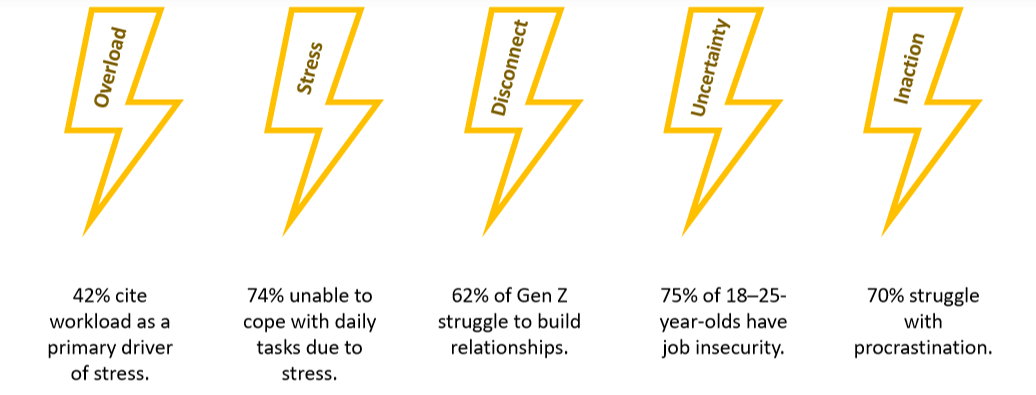
And a result of these chronic everyday stresses, organisations are faced with several critical challenges, including:
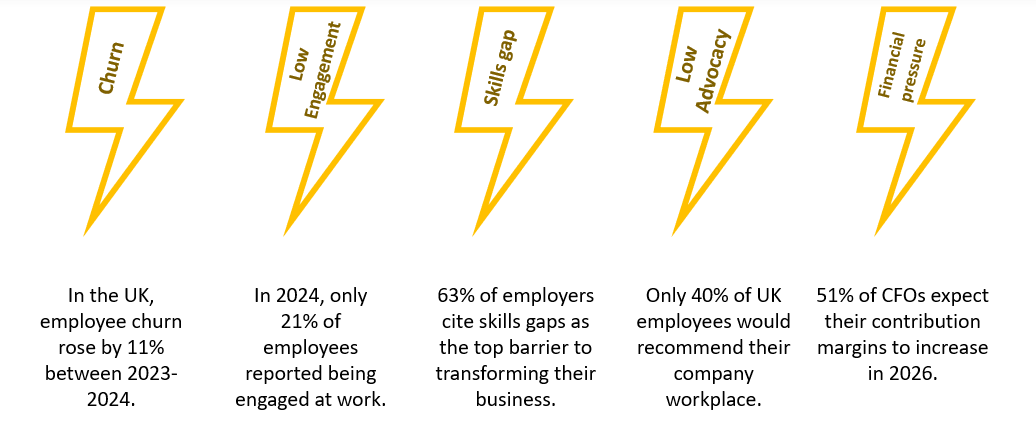
Individuals are reacting faster than organisations. They are seeking out help and support from podcasts, from books, and increasingly from AI agents. While organisations are tending not to prioritise resolving these challenges in a meaningful manner.
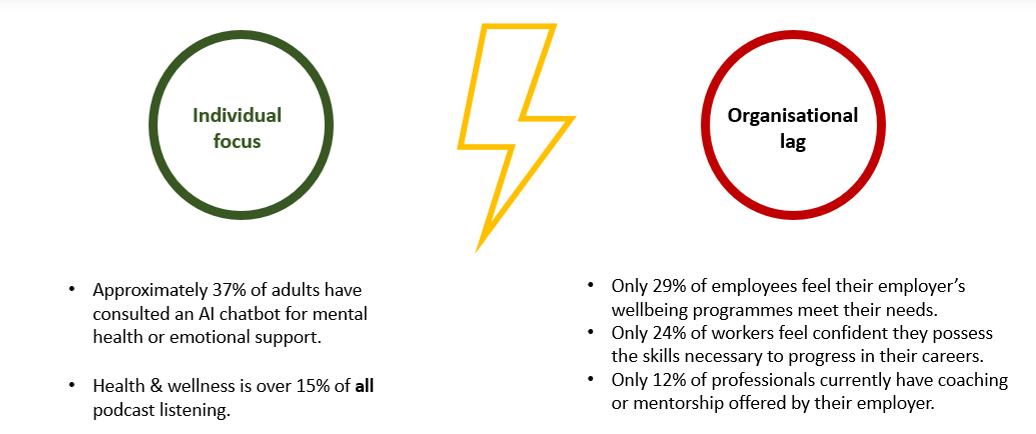
If these challenges remain unresolved, their effect becomes compounded. They become the new normal for more people. And, as a result, organisations face is a progressive decline in productivity. Despite all our new tools and technology, we are suffering from more overload, overwhelm, burnout and inertia than ever before.
We need to stop this cycle.
If these challenges remain unresolved, their effect becomes compounded. They become the new normal for more people. And, as a result, organisations face is a progressive decline in productivity. Despite all our new tools and technology, we are suffering from more overload, overwhelm, burnout and inertia than ever before.
We need to stop this cycle.